NEVERMADE EPISODE #1:
UNEARTHING THE LOST WORLDS OF DAVID LYNCH

(Archive Documentary, In Development)

Project Summary
NEVERMADE EPISODE #1:
UNEARTHING THE LOST WORLDS OF DAVID LYNCH
(Archive Documentary, In Development)
Director: Ryan Mackfall.
Writer: Kingsley Marshall.
Producers: Kingsley Marshall & Ryan Mackfall.
Logline
“I learned that just beneath the surface, there's another world, and still different worlds as you dig deeper. I knew it as a kid, but I couldn't find the proof. It was just a kind of feeling.” - David Lynch
Synopsis
One script, one director, and one movie. We explore Ronnie Rocket, the greatest David Lynch story nevermade.
Unearthing and exploring a passion project from one of the world’s greatest filmmakers, David Lynch, this documentary casts light on Lynch’s unrealised feature film “Ronnie Rocket”, a script he pitched repeatedly throughout his life. At the centre of our film, we awaken a sequence from the screenplay, enriched by the ephemera of what remains. As director, musician, and sound designer, Lynch described sound as constituting ‘at least 50%’ of his movies, and, in our desire to unearth and present this previously unexplored narrative, we will wrap a Lynchian sonic and visual world around Lynch’s own words to foreground his wider working practices. What drives us is the desire to unearth and demonstrate the potential and versatility of archival sources, combining emergent visualisation techniques with innovative sound design and original music to tell a story that respects and builds upon Lynch's legacy.
Style
This investigative documentary is unique – not the usual talking heads, reminiscing about what could have been. Instead, we bring scenes from Lynch’s unmade feature film 'Ronnie Rocket' to life for the first time through combining the techniques used in Guy Maddin’s astonishing 2017 film 'The Green Fog' - a reinterpretation of Hitchcock’s 'Vertigo' reconstructed in a collage of material drawn from television shows and movies set in San Francisco - and the creative use of archive demonstrated in Brett Morgan’s Bowie documentary 'Moonage Daydream' (2022) and Gary Hustwit's 'Eno' (2024).
Over his career, director, musician, and sound designer David Lynch truly believed that the power of the audience listening to his work helped them to read meaning into his films. He and his collaborators deployed a complex combination of sound and visuals to depict mysticism and the impossible, and to articulate and distinguish real-world geographies from the supernatural or embodied, often using sonically distinct liminal spaces to connect these real places to the otherworldly. In this documentary, we make use of similarly intertextual connections to connect conventional and experimental film form as we explore and give a fresh perspective to some of Lynch’s ideas around creativity, filmmaking, and the art life.
The documentary creates Lynch’s previously unmade world via his remaining body of work, the wider film supported by an original score and sound design that does justice to the director’s approaches to the aural dimension of his work, as we explore his thoughts on his artistic and production processes. The intention is to actualise elements of 'Ronnie Rocket' as a creative act and, in doing so, illustrate the working practices, storytelling techniques, and visual and sonic choices that Lynch made in his filmmaking. The tone of our documentary is one of investigation and love; the story illuminated the written, sonic, and visual artefacts from the archive.
Outline
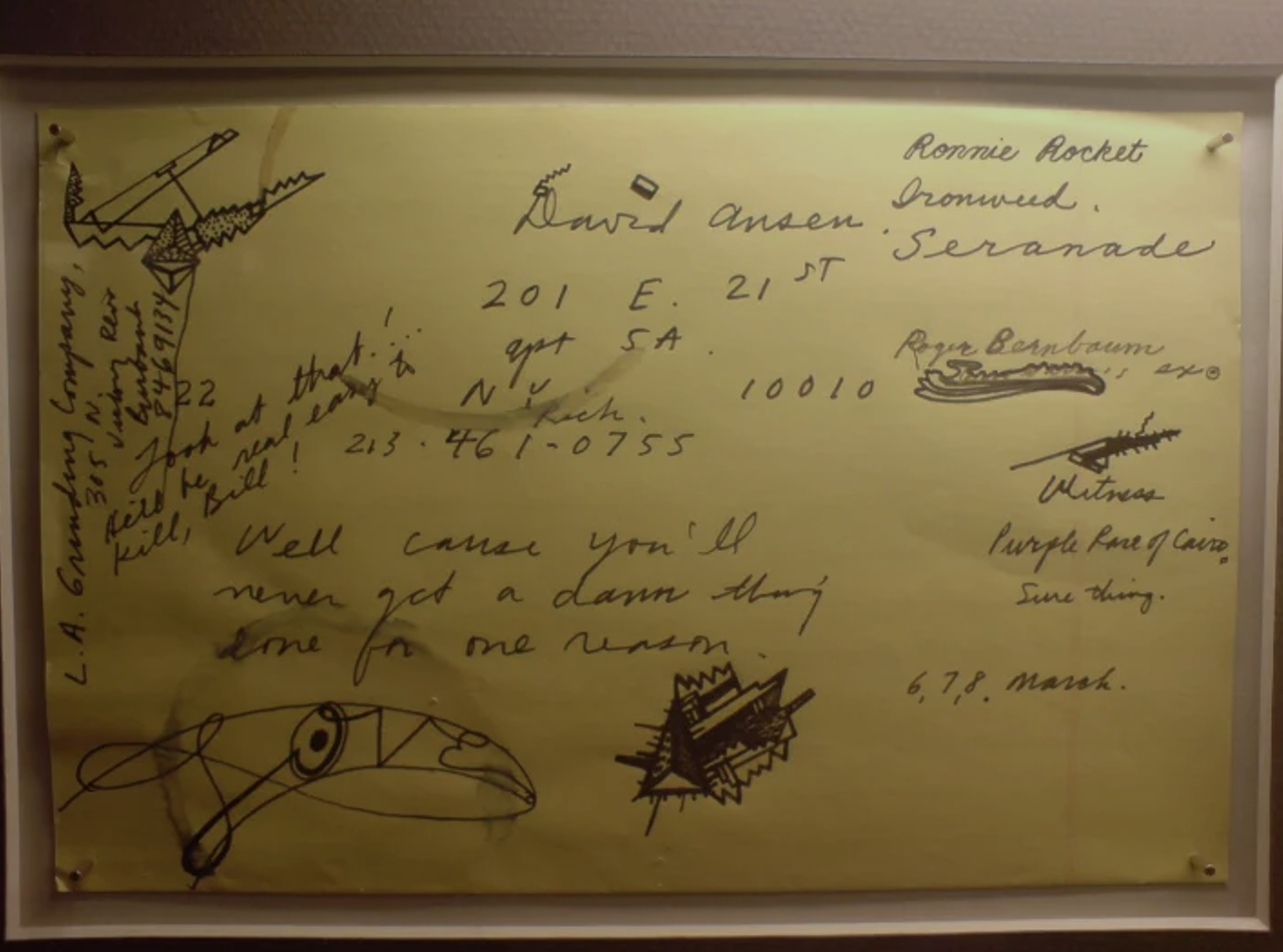
David Lynch had plenty of scripts on the back burner, including two features with Mark Frost that preceded Twin Peaks, but Ronnie Rocket is perhaps the most striking and the one film the director persistently pitched to studio executives throughout his career. The script is adorned with mysterious symbols, and some illuminating pages from the director’s notepad were included in the 2007 art exhibition The Air is On Fire.
In 1971, David Lynch moved to Los Angeles to enrol in a Masters degree at the Centre for Advanced Film Studies housed in the American Film Institute in LA. Signed up to the course on the back of a NEVERMADE screenplay centred around adultery called Gardenback, Lynch ignored the advice of his tutors and dumped that script to begin working on his first feature-length film, Eraserhead, eventually released in 1977.
Lynch intended Ronnie Rocket as the follow-up to Eraserhead, and was described by the writer/director as an “absurd mystery of the strange forces of existence,” featuring "a three-foot-tall guy with red hair and physical problems” with a narrative concerned primarily about the mysteries of electricity. Put on hold for Blue Velvet, Lynch pitched the script to producers after every project he had completed since. Isabella Rossellini, Dennis Hopper, and Dean Stockwell were originally mooted as being attached to the cast, with Michael Anderson in the lead role.
This NEVERMADE will be constructed from the script and archive material held at the Academy Archive in Los Angeles.